
SUSTAINOW brings experts together to advance the assessment of cumulative effects from offshore wind
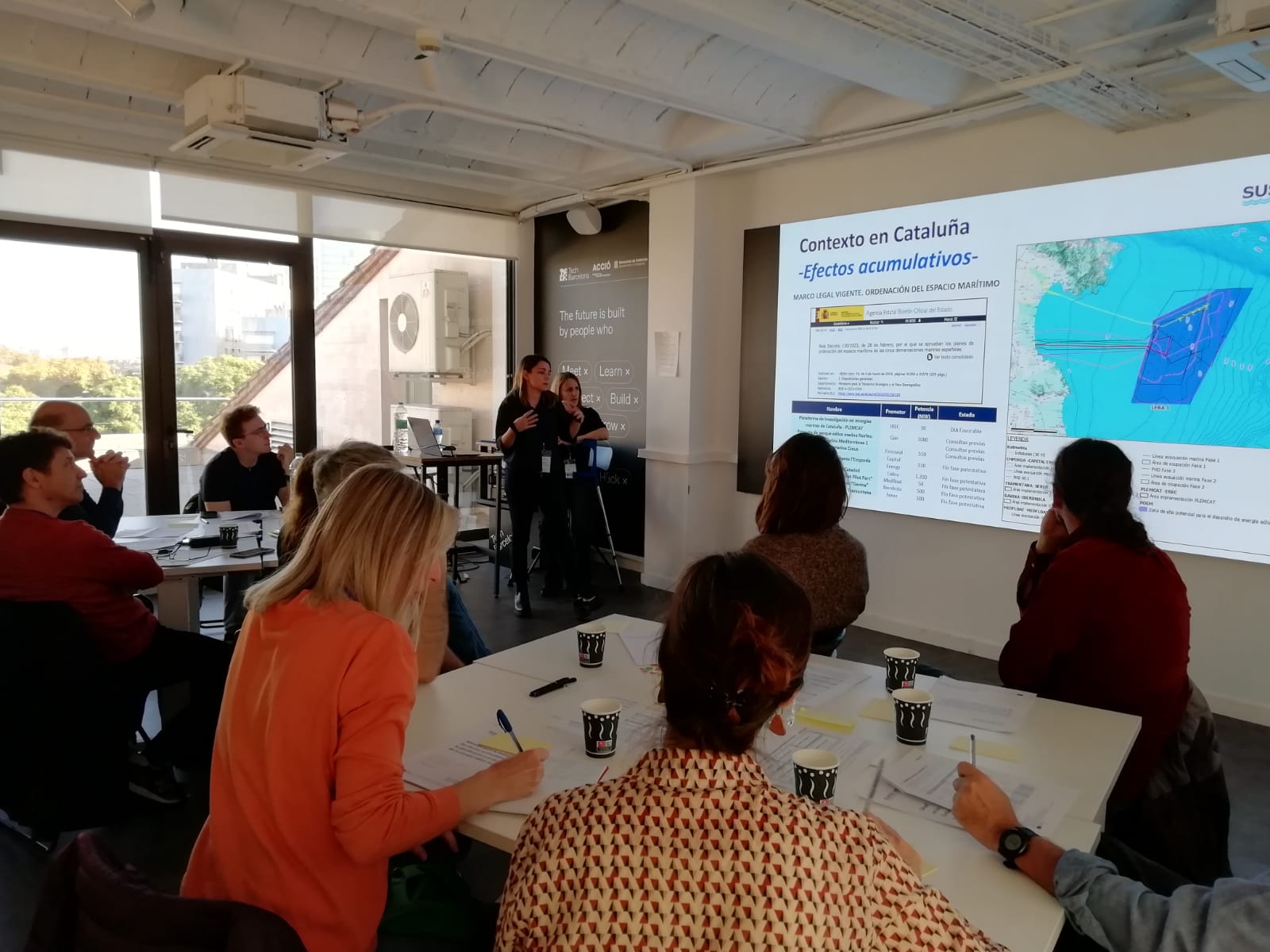
Tecnoambiente and University College Dublin bring together representatives from public authorities, academia, engineering, consultancy and industry in Barcelona to advance a common framework for assessing the cumulative effects of offshore wind farms.
The expansion of offshore wind energy is one of Europe’s major commitments towards achieving a decarbonised energy system. However, the development of multiple offshore wind farms within the same marine area can generate combined effects on marine ecosystems and the various uses of maritime space. Understanding, assessing and properly managing these effects is essential to ensuring that the growth of this technology takes place sustainably.
With this objective in mind, Barcelona recently hosted the workshop «Advancing Best Practice in SEA and EIA», held at Blue Tech Port Barcelona and jointly organised by University College Dublin (UCD) and Tecnoambiente as part of the European SUSTAINOW project, funded by the Horizon Europe programme.
The event brought together representatives from different professional and scientific backgrounds to exchange knowledge and experience, and to advance the definition of the key principles of a reference framework for Cumulative Effects Assessment (CEA) in the development of Offshore Wind Farms (OWFs).
Cumulative effects assessment: a key challenge for offshore wind
Cumulative Effects Assessment makes it possible to analyse how environmental pressures arising from different activities and projects can interact and generate combined effects on environmental receptors. In the context of offshore wind, this perspective is particularly relevant, as impacts should not be analysed in isolation, but also considering the interactions between different infrastructures, activities and components of the marine environment.
Addressing this complexity requires consistent methodologies, appropriate environmental information and shared criteria to improve the quality and comparability of assessments.
This is precisely one of the challenges addressed by SUSTAINOW through its Work Package 3 (WP3), specifically dedicated to cumulative effects. The objective is to develop and test a comprehensive, spatially specific framework applicable to different marine contexts, helping to improve decision-making in the siting, design, construction, operation and decommissioning of offshore wind farms.
A collaborative working space to advance best practice
During the workshop in Barcelona, participants worked together on four key aspects to help define a robust and practical methodological framework:
- Key steps in Cumulative Effects Assessment: identifying and structuring the main stages that should be included in the assessment process.
- Definition of pressures and environmental receptors (pressure-receptor definitions): identifying the pressure factors associated with human activities and the components of the marine environment that may be affected.
- Pressure-receptor interactions: analysing the relationships between different pressures and environmental receptors, taking into account the complexity of marine ecosystems.
- Effect significance qualifiers: identifying the criteria that should be considered when determining the significance of cumulative effects.
The discussions provided an opportunity to address these elements from different professional perspectives, bringing together experience and technical knowledge to contribute to a shared understanding of the main challenges and needs in cumulative effects assessment.
Engaging key stakeholders is essential to moving forward
One of the main strengths of the event was the diversity of participants. The workshop brought together professionals from public authorities, universities and research centres, engineering companies, environmental consultancies, and representatives from the offshore wind and maritime industries.
Participating organisations included X1 Wind, the Spanish Wind Energy Association (Asociación Empresarial Eólica), the Government of Catalonia (Generalitat de Catalunya), ICATMAR, Esteyco, the Catalan Energy Institute (Institut Català d’Energia), the University of Barcelona, Ocean Ecostructures, BCN Port Innovation, the University of Girona / Renovem-nos, SENER, Minuartia, YouWind and independent professionals.
This diversity enriched the discussions with complementary perspectives, fostering an open and constructive dialogue on how to improve methodologies and their practical application in environmental assessment processes.
SUSTAINOW: towards more sustainable offshore wind planning
SUSTAINOW (SUSTAINable Offshore Wind) is a European research and innovation project working to improve site identification and the sustainable design of offshore wind farms throughout their entire life cycle.
The project focuses on three main areas of innovation: a cross-border marine data space to improve data accessibility and interoperability; an evidence-based tool to support site selection; and a tool to guide the holistic design of offshore wind projects and anticipate and manage their environmental, social and economic impacts.
In this context, developing a framework for cumulative effects assessment is a key component. Its purpose is to strengthen existing methodologies for Strategic Environmental Assessment (SEA) and Environmental Impact Assessment (EIA), enabling a more comprehensive consideration of environmental pressures, ecosystem vulnerabilities and interactions between activities in the marine environment.
Collaboration with the different stakeholders involved is essential to ensuring that the solutions developed address both scientific needs and the practical challenges of their application in offshore wind planning and project development.
Tecnoambiente would like to thank University College Dublin for its collaboration in organising the workshop, as well as all the participating organisations and professionals for their valuable contributions and active engagement.
The transition towards truly sustainable offshore wind requires us to understand how impacts add up. Achieving this calls for collaboration between science, public authorities and industry.
Find out more about the project and its open-access tools at www.sustainow.eu